WikiConference North America 2025 Recap: Gun, Community, Leadership, Permission2025-10-24
Who doesn't want to read a 2,100-word conference recap, right?
WikiConference North America (WCNA, Wikicon) is probably my favorite conference of the year. This year's event was here in NYC, and in many ways it was everything I love about this conference: interesting presentations, collaboration, and most importantly meeting people I've known online for years. But on the first day, a man draped in a flag took the stage during a keynote and pulled out a gun, threatening to kill himself. (Before I go on: no shots were fired; nobody was hurt).
Let's Get This Part Out of the Way
I always regret committing to present more than one talk at a conference. Some of my most productive, enjoyable conferences are those that I attend without presenting. With two, even when I'm fully prepared I find I'm too preoccupied to enjoy other sessions until mine are done. This event followed a week and a half of traveling and two revise-and-resubmits, so at the start of the conference I was next door at the food hall, drinking coffee and tidying up a slide deck with my co-author on one of the talks.
Thankfully we didn't have much to do, because it wasn't long after we sat down that a security guard came over to tell us we had to evacuate the building. He didn't want to say why.
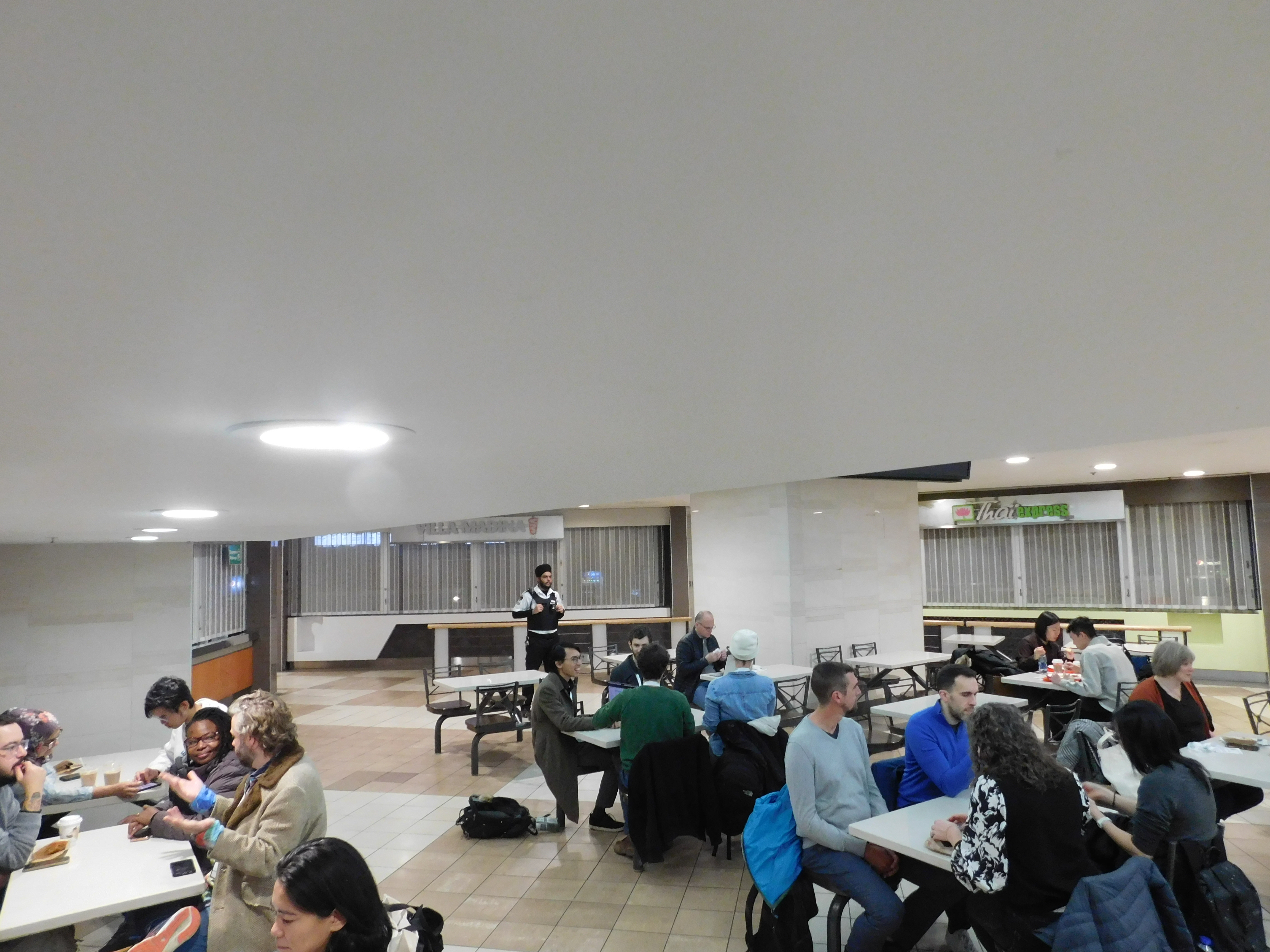
Two years ago, Wikicon was in Toronto. The morning of the second day, there was a bomb threat. An aggrieved Wikipedian who had been blocked, banned, or otherwise thwarted, had hacked some gym's website to make various threats, cross-posted on Twitter with the conference hashtag. It was maybe 90 minutes' inconvenience as we gathered in a train station food court next door and had productive conversations: the design of the upload wizard on WikiCommons, owl behavior, using AI for article translation, and so on. I'd describe the mood as "mildly shaken, but eager to get back to work." Then we proceeded with the conference. The photo to the right shows one nook of that food court, awkwardly framed in order, I think, to respect the wishes of those who understandably did not want to be photographed.
As we walked out of the Time Out Market last Friday, we assumed it was a similar kind of disruption. On the way out, however, two words quickly shifted my feelings: active shooter.
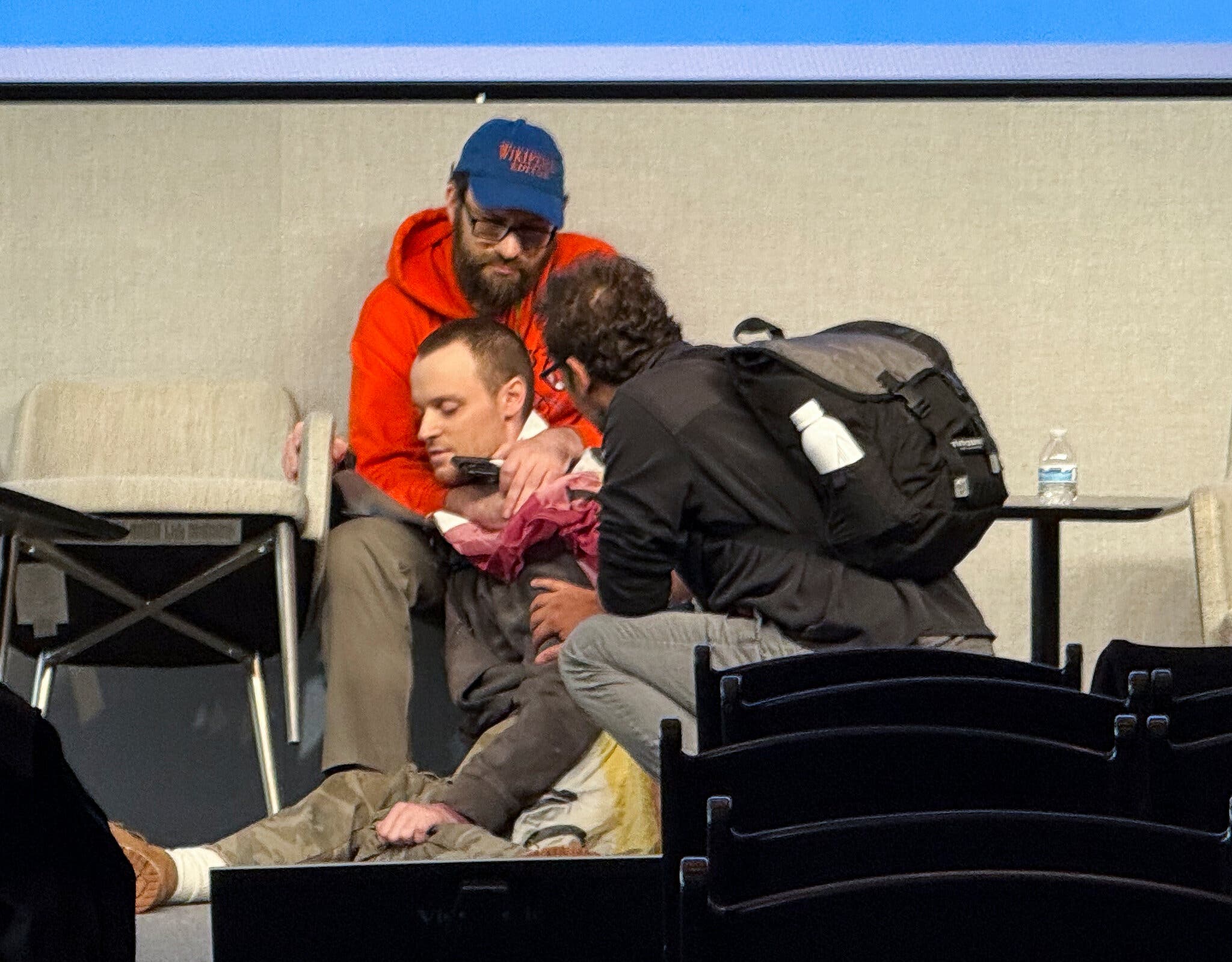
One of the first people I saw was a fellow WikiNYC member, who showed me a shocking photo: two friends of mine holding a distraught man on stage. Similar to the one which ran in the Times' story about the incident (pictured).
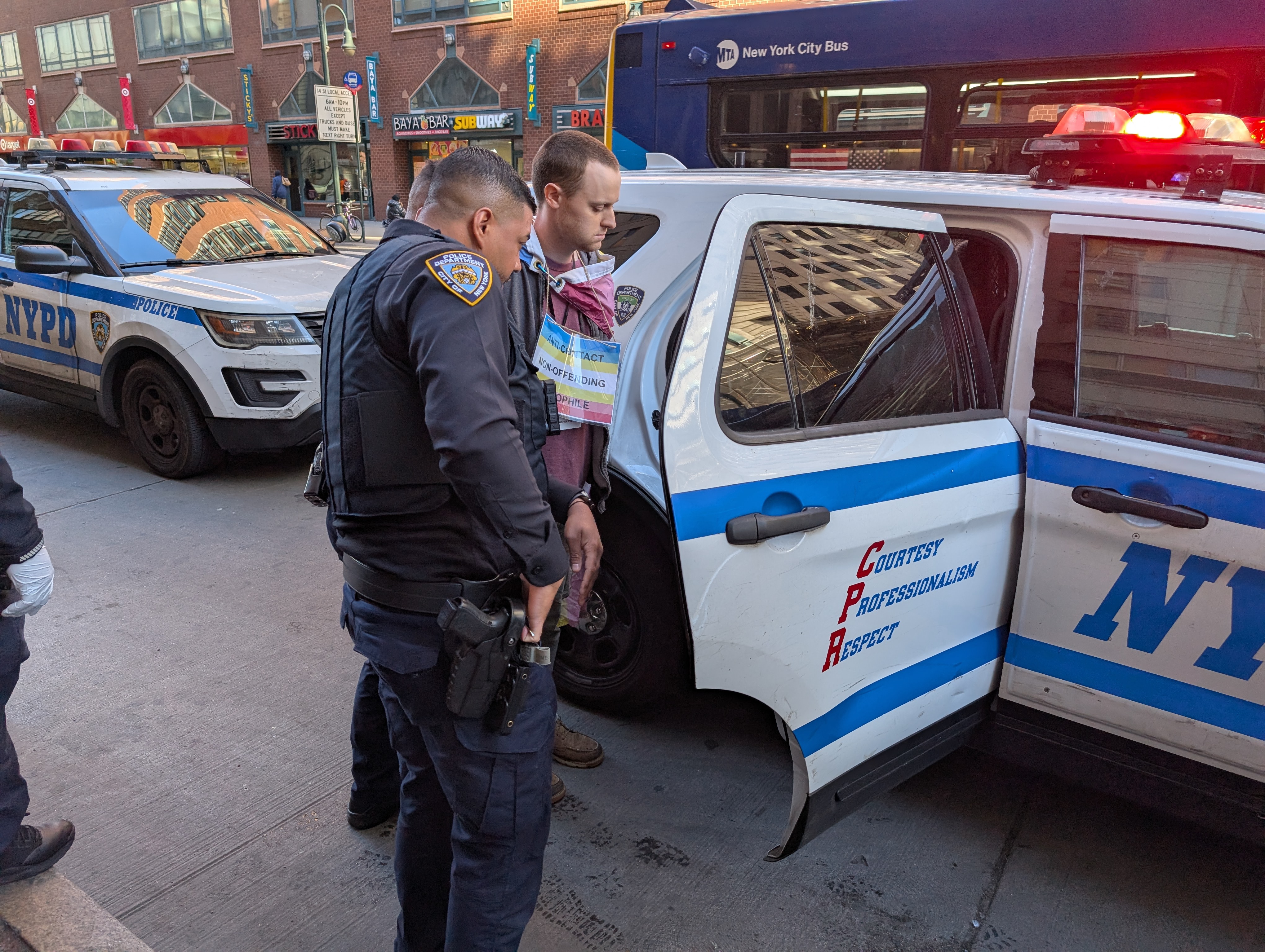
Then I saw the police walking that man out of the building and into a police car (pictured).
This is what happened: shortly after the opening keynote by Wikimedia Foundation CEO Maryana Iskander, a man got up on stage. He had draped himself in a "minor-attracted person" flag (both this term and the flag have fraught, troubling histories that I'm not going to get into here). He also wore a sign around his neck saying something like "no-contact non-offending pedophile." The man announced himself as such and expressed anger at the English Wikipedia's child protection policy, a bright-line rule which, among other things, says that if you announce that you are a pedophile on Wikipedia, we will ban you (and does not make exceptions for "non-offending" individuals).
He drew a gun, waved it around, and then pointed it at himself, expressing an intention to kill himself. Richard Knipel rushed the stage and grabbed the man from behind as Andrew Lih came over to pry the gun from his hand. Jake Orlowitz then approached to try to calm the man down until police arrived.
Nobody was hurt, but it was a far scarier situation than what happened in Toronto — traumatic for many in the room. Scheduled events were canceled for the rest of the day as attendees socialized and supported each other in the conference venue. By this point, news media were starting to pick up the story. This NYTimes article, published a few hours later, is probably the best piece to come out that day. (NYT also thoughtfully retitled another article about the conference, published a few days prior, that had the unfortunate headline, "A Weekend of Settling Wikipedia Scores," referring to the pedantic arguments Wikipedians are prone to — nothing quite so dramatic.)
I'd especially recommend checking out Stephen Harrison's Slate article (archive), which came out a few days later. Stephen spends a lot of time getting to know the community, individuals, and internal processes on Wikipedia, and it shows in the quality of his coverage (which is high-praise I'd share even if I weren't quoted in the piece!).
Community
An impromptu gathering was announced for that evening, with security presence, at a local venue. It began with an exercise that had us form a circle. A counselor was on-hand, leading breathing exercises and encouraging people to share their thoughts and feelings. Around the circle, we expressed fear, uncertainty, guilt, relief, and gratitude. Then the counselor announced her availability to talk privately and we resumed an otherwise normal conference-night party: pizza, laughing, and talking about how to improve Wikipedia, punctuated with the occasional somber comment.
In talking with journalist Bill Adair (who also took that NYTimes photo above) earlier in the day, he made a great observation that I'll try to paraphrase: you could imagine, at some events or among many groups of people, if something like this happened the crowd would be calling for retaliatory violence and angry retribution. Here, the contrasting response said a lot about the Wikipedia community: tackle the problem head-on (literally), then support each other and get back to work.
Discussions are ongoing about what could've been done differently, how to proceed in the future, and Wikipedia's recently politicized role in the US, but I found myself moved by the resilience and compassion exhibited by this community.
A Note on Leadership
As I stood outside the food hall, piecing together what happened, I thought "what a coincidence that the two people who intervened are two of the people who have been part of this community for the longest".
But it's not a coincidence; it's leadership.
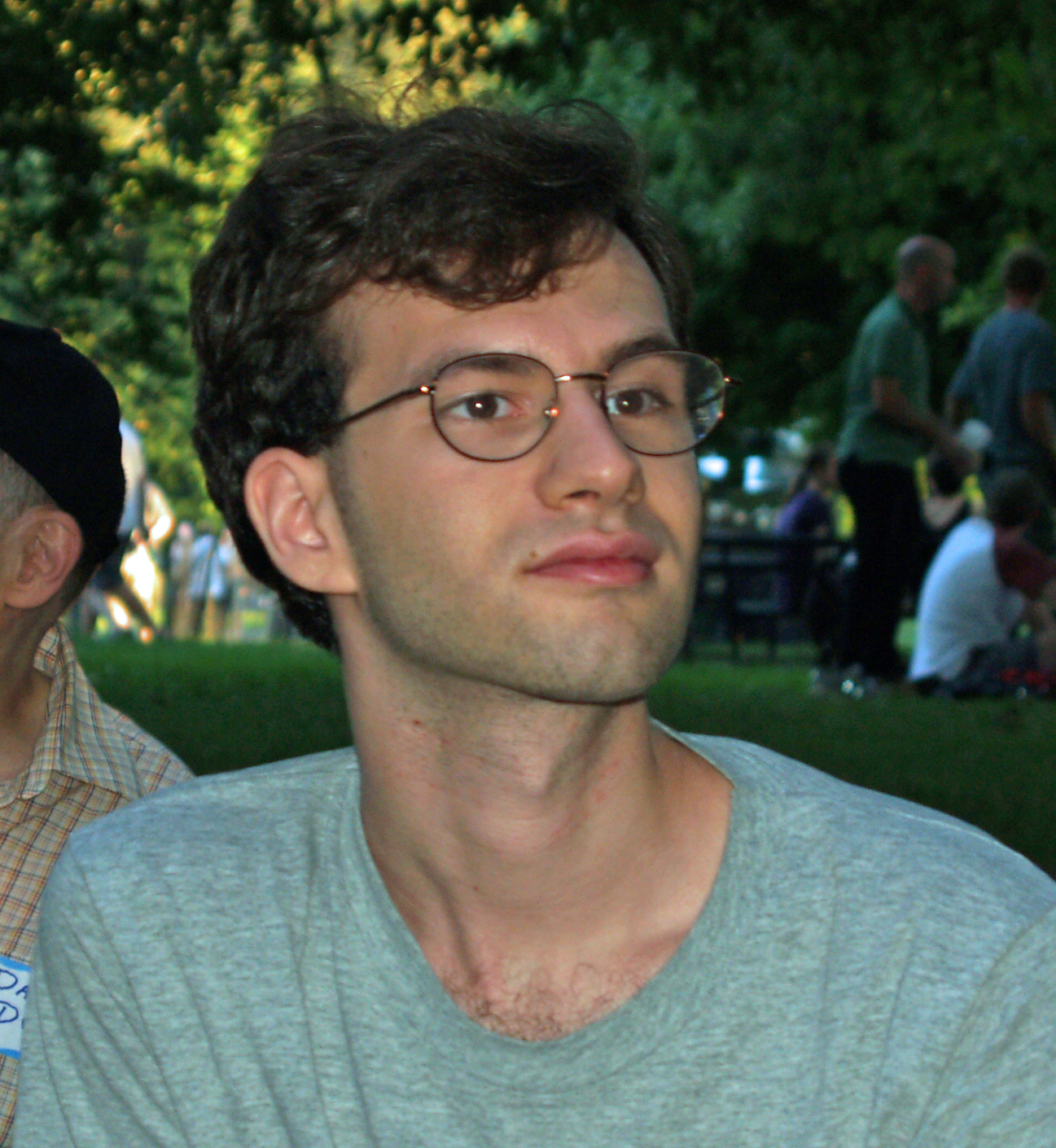
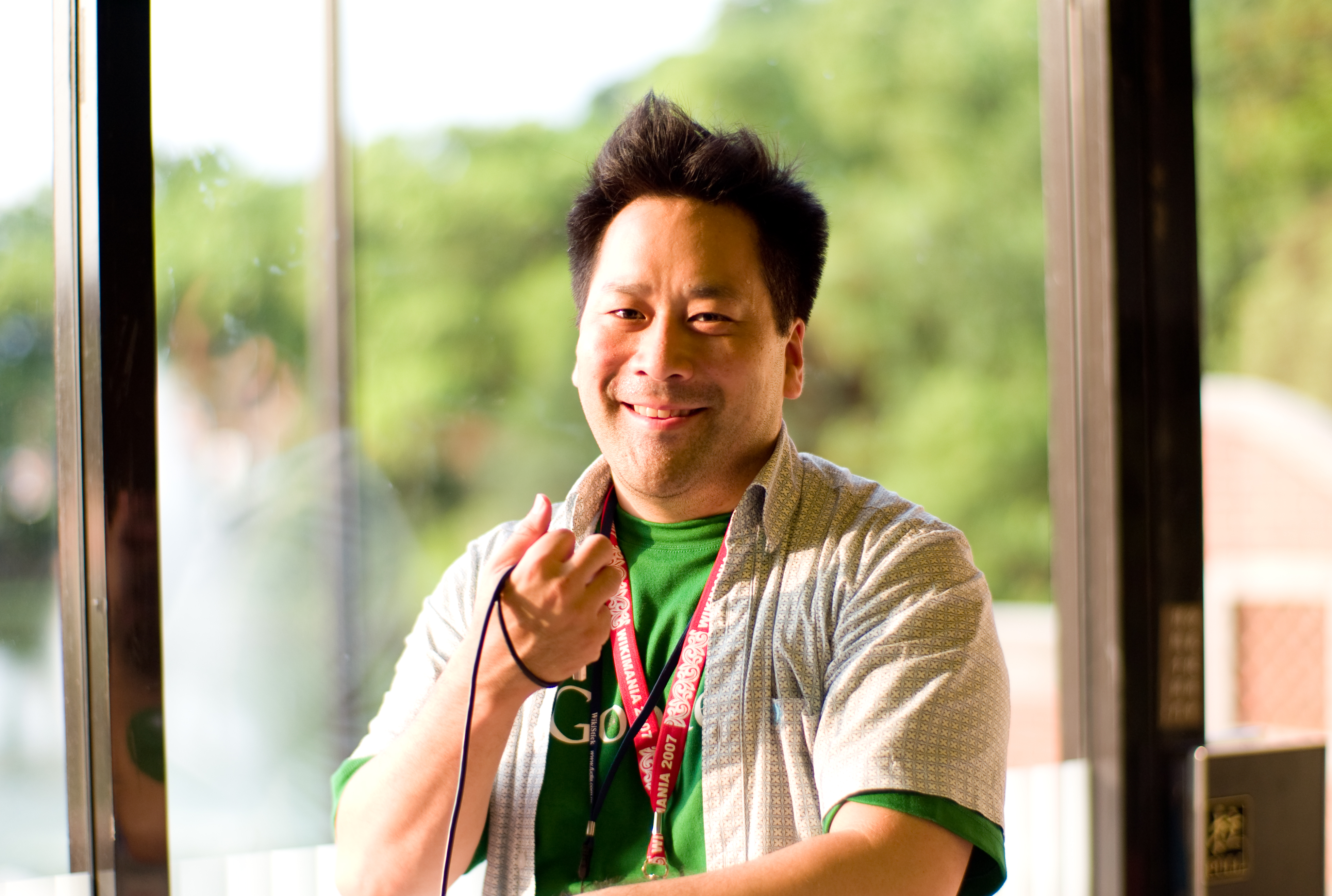
Richard and Andrew have indeed been around for a long time — a combined 43 years (!) — but they've been active organizers and leaders within this community for nearly as long (both pictured in 2007). The people who spring into action in such cases aren't the no-nonsense tough-guys from the movies; they're the movement leaders who feel a loyalty and a responsibility to the community they've helped to create and bring together.
I jokingly suggested that we'll have to create a new Wikimedian of the Year category for them (an annual recognition bestowed by Jimmy Wales) — joking because obviously we don't want a category that suggests this will be the kind of incident that happens again. But maybe we do need a category for leadership.
Frankly, I think this movement could do more to cultivate and train leaders. While there's something to be said for the contradiction between the way Wikipedia's articles are written and celebrating individual leaders, the reality is that the Wikipedia community is full of both leaders and potential leaders. Not just in-person organizers, but the administrators willing to make and discuss tough calls, those who volunteer on the Arbitration Committee (sort of like Wikipedia's unpaid Supreme Court), those who coordinate subject-specific "WikiProjects," the people who coach new users on how to write "Featured Articles," and so on.
I don't want to divulge details of the "sharing circle," but I'm confident Richard wouldn't mind my saying this: after others expressed anxiety, he explained that he gets anxious about his role in these events, too, and what helps him is to … write Wikipedia articles. He then told us about his newest article, the "Pope in the White House" conspiracy, laughing as he lightened the mood in the most predictably, charmingly nerdy way possible. Appreciate you guys, a lot.
Permission to Publish
My first talk was canceled as it was scheduled for the first day. Matt Vetter and I have been working on a project which examines high-profile cases of community-side content moderation on Wikipedia, finding a pattern of competing sociotechnical imaginaries which emphasize Wikipedia as primarily a community vs. primarily an encyclopedia. From what we can tell, and as we named the talk, "the encyclopedia always wins." Hope to wrap that paper up in the near future.
That left my shorter talk on Sunday, "Permission to Publish." The gist is this: the most important difference between Wikipedia and encyclopedias throughout history isn't that Wikipedia isn't paper, that it's accessible to everyone for free, or that anyone can edit — it's that, unlike nearly all of its predecessors, Wikipedia doesn't need anyone's permission to publish. Whether Roman emperors, church officials, publishers, or financiers, encyclopedists have historically needed support and/or authorization from someone to write, copy, and disseminate their work. So, because Wikipedia has not been required to go to power, we are in the era when power has come to Wikipedia. It was a short talk — just the opening hook for a larger project I'm working on, based in part on my dissertation. More on that soon. I'm grateful to Stephen Harrison for including it as the conclusion for his write-up on the conference.
Conference Sessions
Two days of conference did indeed take place. Here are some quick notes on interesting sessions I attended:
- One of the most discussed recent findings comes from this WMF blog post. The takeaway is that human visitors are down 8% while bot traffic has increased. In other words, AI is eating Wikipedia traffic.
- Personally, I'm most interested in how this might affect participation. If people are going to Wikipedia, they can't then be introduced to the "edit" button.
- It's a controversial take, but I don't actually think transferring traffic to other platforms is entirely bad (ok, maybe mostly bad). If people are going to ChatGPT for information and that information comes in large part from Wikipedia, we're still accomplishing our goals. Our mission isn't to maximize page-views, after all, but to serve as a free knowledge resource. The audience for Wikipedia is not a direct subset of Google/ChatGPT users, which means possibly reaching users we wouldn't otherwise reach (whether due to variation in information-seeking habits or perhaps lack of trust). More to say about that, but that's the gist. The Foundation is understandably worried about banner clicks and donations, and many in the community are disappointed about the lack of attribution, which is also an entirely valid gripe.
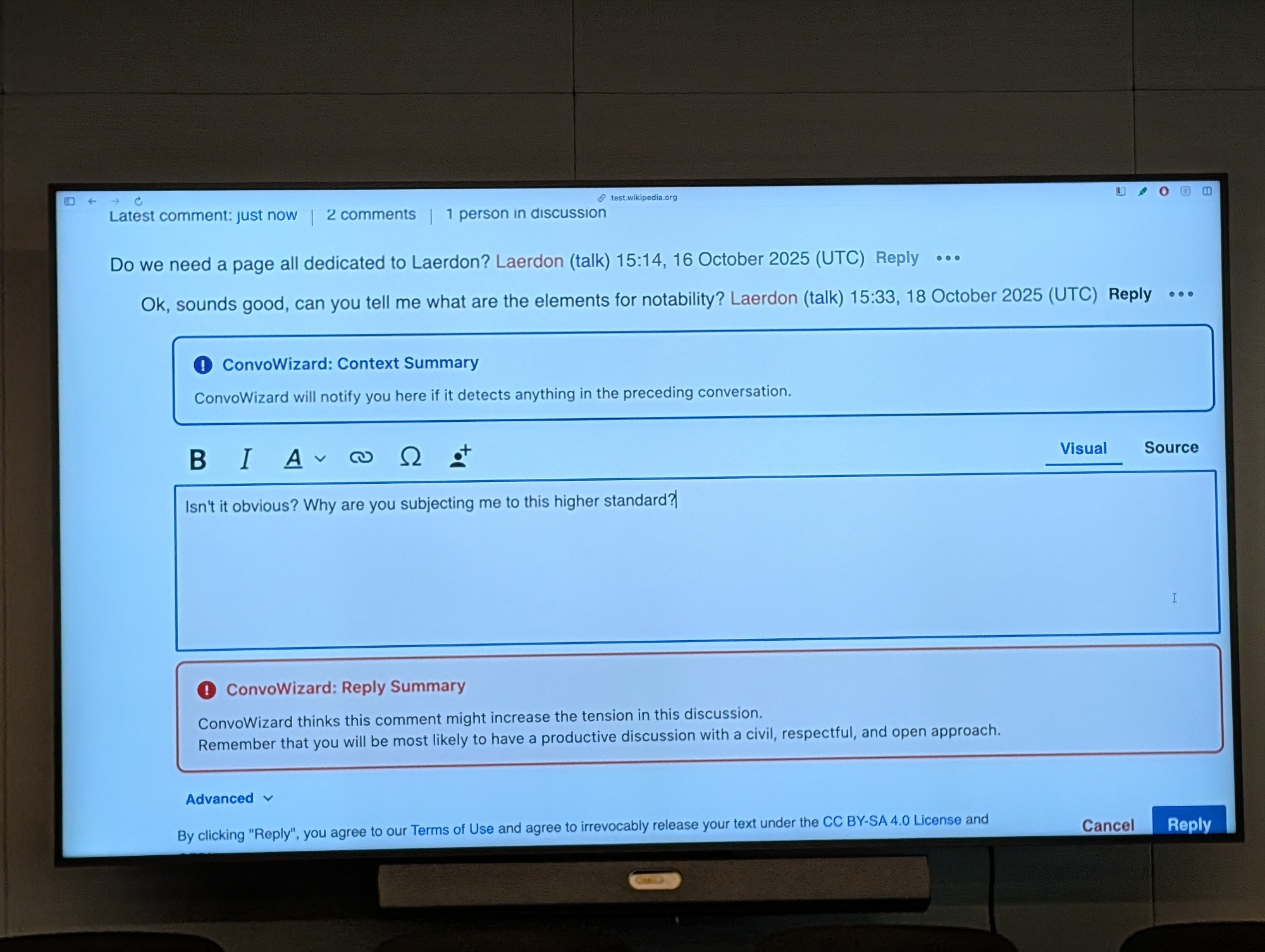 Cristian Danescu-Niculescu-Mizil and Laerdon Kim at Cornell have a new interface tool, ConvoWizard (pictured), to give people a chance to reword or reconsider when starting to veer a Wikipedia discussion into counterproductive incivility. Seems thoughtfully designed, and based on an existing dataset of "escalation" statements. Not publicly available yet, AFAIK.
- Bonus: Learned about Slido, an apparently functional audience participation tool that I'll look forward to experimenting with.
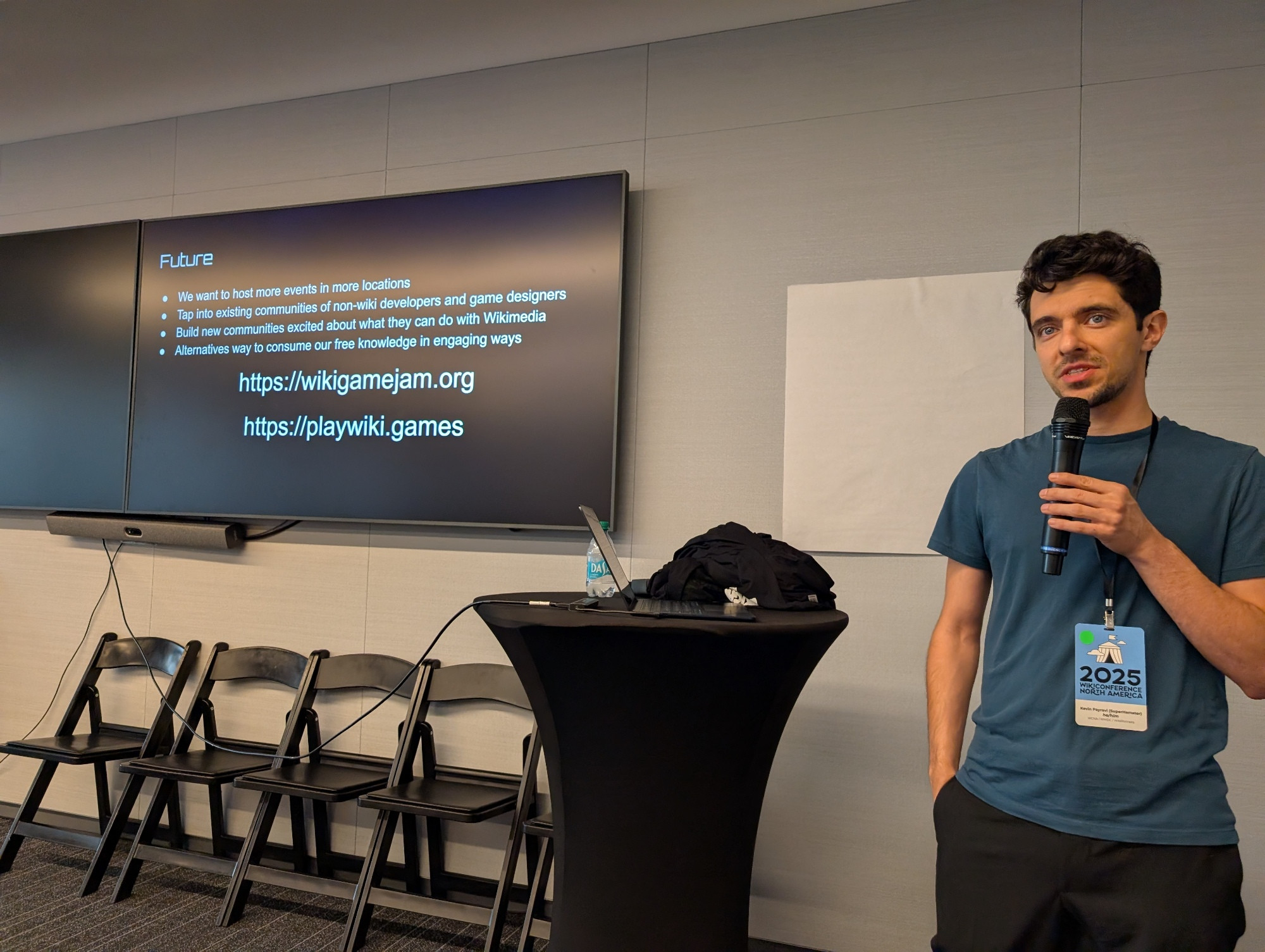 Because Wikipedia and Wikidata are free and open, many people use the data to create games. Kevin Payravi has been hosting "Wiki Game Jams" to support people who want to do so, and created playwiki.games as a sort of arcade linking to wikigames (pictured).
- By default, Tor and other open proxies are not allowed on Wikipedia for fear of abuse. It's controversial, but there are exceptions. Sohom Datta gave a lightning talk on the Kafkaesque reality of trying to get one of those exceptions.
- The English Wikipedia tends to discourage gallery sections for most articles, but readers like them. Olga Vasileva explained how the WMF is trying to make it possible for those users to access galleries without changing articles themselves.
- The WMF Research team presented ToneCheck, a tool which can flag problematic "tone" issues (peacock terms, slang, etc.), and can be configured to advise users as they start to write said language or to signal to other users that a tone problem may exist.
Once a Blog Post Exceeds 2,000 Words, It Needs a Conclusion Section, Right?
Memorable conference in more ways than one.
I hope my fellow attendees have someone they feel comfortable talking to as we collectively work through this experience and consider its implications for the future. Personally, I feel a modicum of irrational guilt for having been next door, but mostly I think I was just saddened to be reminded [again] of a new reality that I regularly try to forget: that volunteering to summarize what other people have written for a free public resource is a risky hobby.
On the whole, most attendees I talked to seemed to leave feeling more connected to the Wikipedia community and more motivated to carry on. Though I'm especially sad for the first-time attendees who don't have 5, 10, 20 years of positive experiences to weigh this against. I haven't heard anyone say they wouldn't come to future events, but there's a strong push for increased security like bag checks, metal detectors, and registrant screening. It's hard to argue, even if increased security carries with it some other considerations. To some small degree, for better or worse, the feeling of these big events might be forever changed.
.jpg)
Last updated:
2025-10-24
Text licensing:
By Ryan McGrady. CC BY 4.0 (you can use/republish this).
Media licensing:
Photo: Food court in Toronto, by User:Mitchazenia, CC BY-SA 4.0
Photo: Wikipedia Volunteers Avert Tragedy in NYC, by Bill Adair, published in the New York Times, All Rights Reserved by default (fair use here)
Photo: NYPD placing the man in a police car, by Ryan McGrady, CC BY-SA 4.0
Photo: Richard Knipel in 2007, by David Shankbone, CC BY-SA 3.0
Photo: Andrew Lih in 2007, by Joi Ito, CC BY 2.0
Photo: ConvoWizard, by Ryan McGrady, CC BY-SA 4.0; Interface by Cristian Danescu-Niculescu-Mizil and Laerdon Kim
Photo: Kevin Payravi, by Ryan McGrady, CC BY-SA 4.0
Photo: Pine warbler in Green-Wood Cemetery, Brooklyn, by Ryan McGrady, CC BY-SA 4.0


